
Hello everyone! I am Kawamitsu, the LFC representative.
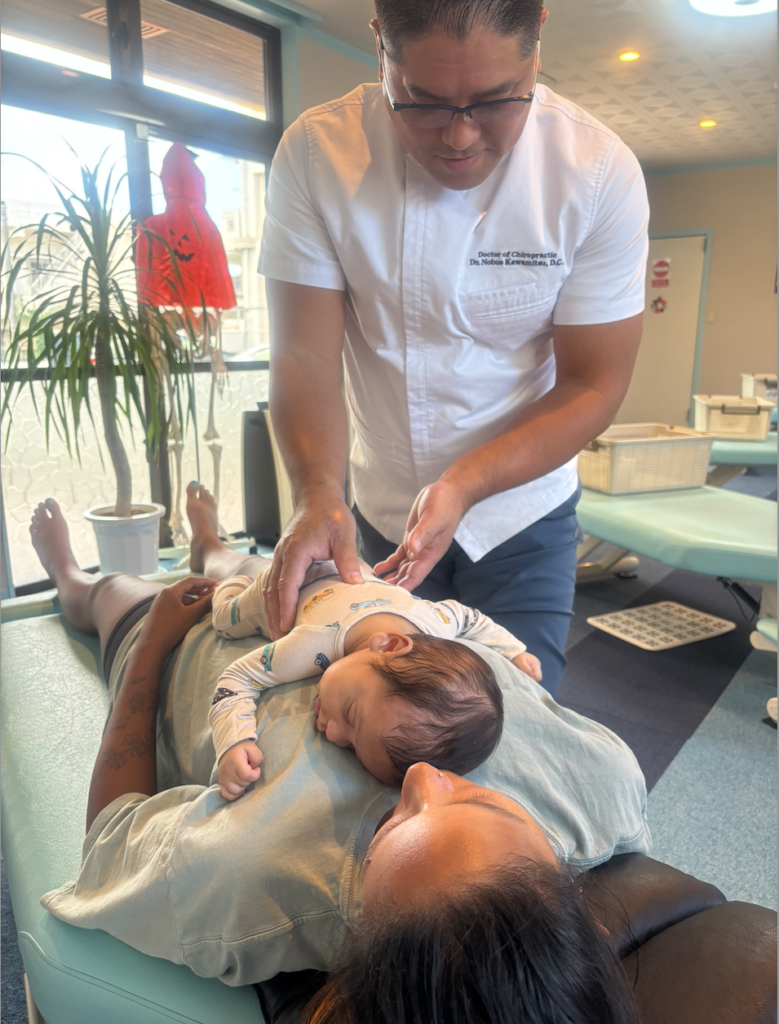
The other day, we had a baby patient come in for the first time in a while. When I asked the mother, she said the baby had been crying a lot at night, and even during the day, the baby seemed uncomfortable when put down to sleep and would fuss.
We’ve had several infant patients with the same symptoms in the past, and upon investigating the cause, it appears to stem from “misalignment of the neck and back.”
When a baby is born, it passes through the birth canal, and during this process, the open sections of the skull naturally close. However, when a baby is born via cesarean section—without passing through the birth canal—the shape of the head can become deformed. Also, while babies generally emerge head-first during birth, if the part of the body below the head is slow to emerge, the midwife may pull on the baby’s neck or use a vacuum extractor to pull the head out. During this process, the shape of the head can become elongated upward or backward, leading to deformation, which in turn can cause misalignment in the neck.
Furthermore, even in normal vaginal deliveries, the SOT technique I use is known to make the baby’s neck prone to misalignment.
Generally, misalignments in the body's joints do not correct themselves on their own, so if a joint remains misaligned, it can press against the nerves running nearby, causing discomfort.
Then, as children grow a little and start walking and running, the impact of falling causes their knees and pelvis to shift out of alignment, and their entire spine begins to become misaligned as well. And if you leave this misalignment untreated, here’s what happens: it’s a bit embarrassing to admit, but from as far back as I can remember until around fourth grade, I wet the bed every night. Furthermore, spinal misalignment can contribute to conditions like atopic dermatitis, and it can lead to a wide range of symptoms, including middle ear infections.
Therefore, receiving spinal adjustments from as early an age as possible can help prevent illnesses and symptoms later in life. As I’ve mentioned a few times on my blog, when I was still in the chiropractic doctoral program, there were one or two classmates in each class whose parents were chiropractic doctors.
One thing these people often said in unison was, “I’ve never gotten sick or had to see a doctor.” I believe that by continuing to receive chiropractic adjustments from their parents, they were able to maintain a strong immune system and prevent themselves from getting sick.
Why Do Babies Need Chiropractic Care?
Hello, everyone! This is Kawamitsu, the representative of LFC.
Recently, a baby came in for a visit at the clinic—the first one in quite some time. The mother explained that the baby cries a lot at night and gets fussy during the day whenever laid down, as if feeling uncomfortable.
I have seen other babies with similar symptoms, and when investigating the root cause, it often points to “misalignment in the neck or back.”
When a baby is born, it passes through the birth canal, a process that helps the open areas of the skull (fontanelles) close. In cases of cesarean section, where the baby does not pass through the birth canal, the shape of the head may be altered. Furthermore, even in vaginal births—where the head typically emerges first—if the rest of the body does not follow easily, the neck might be pulled, or a vacuum extractor might be used on the head. This can cause the head to become elongated (either upward or toward the back), which in turn leads to misalignment in the neck.
Even in standard vaginal births, the chiropractic technique I use—known as SOT (Sacro-Occipital Technique)—recognizes that a baby’s neck is particularly prone to misalignment.
Generally, joint misalignments in the human body do not correct themselves. When a joint remains misaligned, it can press against nearby nerves, causing discomfort.
As a child grows and begins to walk or run, the impact of falls can cause the knees or pelvis to shift, eventually leading to misalignment throughout the entire spine. If these misalignments are left untreated, what can happen? Well, to share a personal (and somewhat embarrassing) detail: from the time I became self-aware until about the fourth grade of elementary school, I struggled with chronic bedwetting. Spinal misalignment can also be a contributing factor to conditions such as atopic dermatitis (eczema) and middle ear infections, among various other health issues.
Therefore, receiving spinal adjustments from a very young age can help prevent or minimize the development of illnesses and symptoms later in life. I’ve mentioned this on my blog a few times before: back when I was in the chiropractic doctoral program, I had a few classmates—one or two in various classes—whose parents were chiropractors.
What they all consistently said was that they had never once been sick enough to need to see a doctor. I believe this is because, by receiving regular chiropractic adjustments from their parents, they were able to maintain a strong immune system and prevent themselves from getting sick.

 English
 日本語